Malaysia’s New EWS Uses Cell Broadcast: What the Tests Mean for Your Phone
Malaysia’s new Early Warning System (EWS) is designed to send emergency alerts to compatible phones in a selected area using Cell Broadcast System (CBS). A simulation around Parliament was scheduled for 23 November, followed by a nationwide alert test on 29 November, according to Communications Minister Fahmi Fadzil’s announcement reported by RTM on 19 November.
That does not mean every phone will receive every alert, or that SMS and sirens are being switched off. The practical step for phone owners is to install available software updates, restart the device, and check its emergency-alert settings. MCMC’s preliminary compatibility guidance is still subject to final technical confirmation.
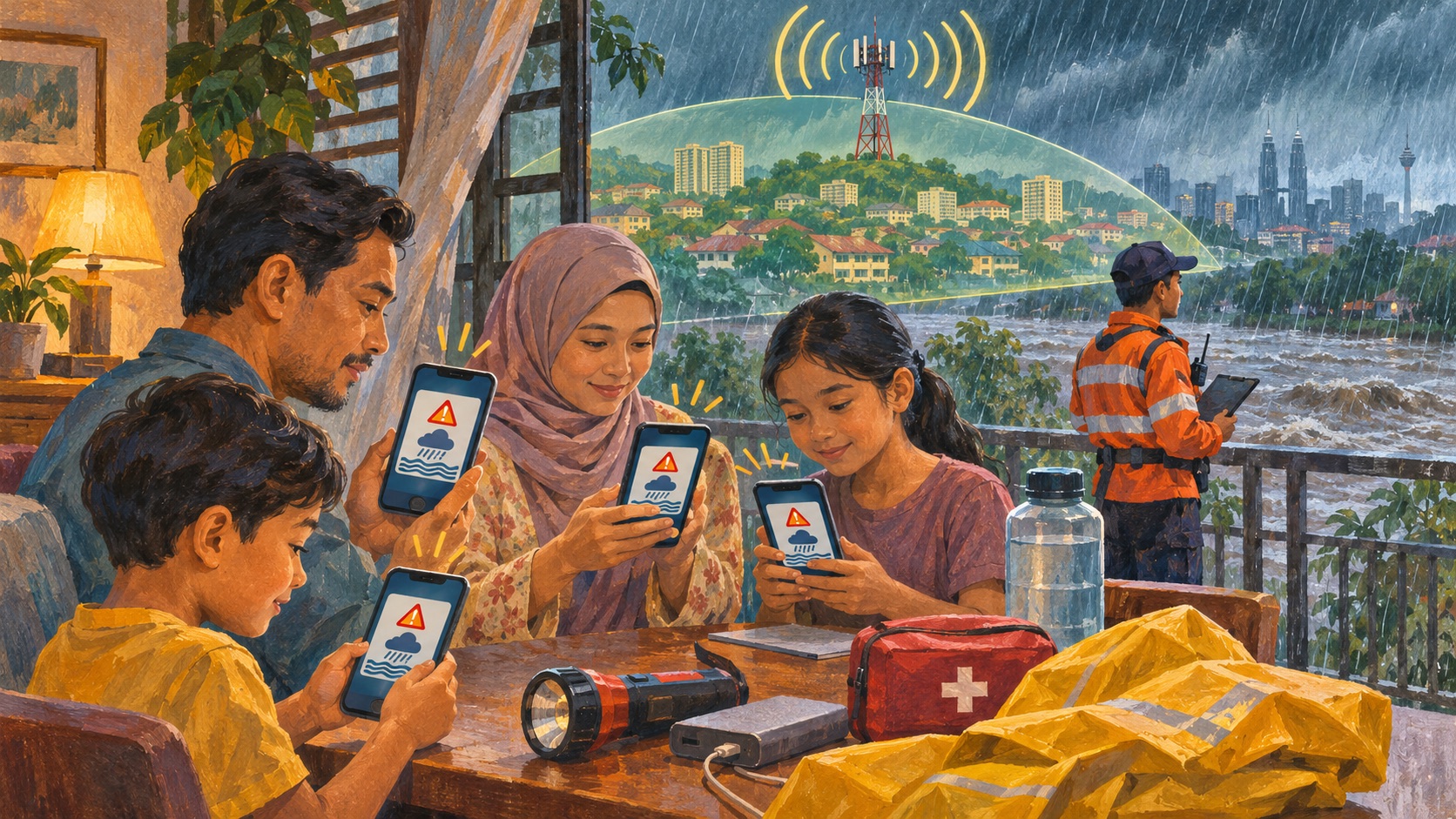
Editorial illustration: one area-based broadcast can reach compatible phones in the selected mobile coverage area.
Summary
- EWS uses CBS to send a pop-up emergency alert to compatible phones in a designated area; it does not require an app, registration, or subscription.
- The Parliament-area simulation was scheduled for 23 November, with a nationwide test scheduled for 29 November. Check current official notices for any updates to test arrangements.
- MCMC’s preliminary device guide lists iPhone 11 or newer on iOS 27.2 or later, Android 12 or later, and Huawei devices on EMUI 16 or later, subject to final technical verification.
- SMS and some existing siren systems remain part of Malaysia’s wider warning channels. A phone that does not receive CBS should not be treated as proof that an area is safe.
What is being tested
RTM reported that the 23 November simulation was planned for the Parliament area, followed by an alert test across the country on 29 November. The purpose is to show how the notification appears and sounds, and to help people distinguish a system test from a real emergency warning. The announced dates are schedules, so follow MCMC, NADMA and other official channels for any later instructions about timing or message wording.
The system is being implemented in phases by the Malaysian Communications and Multimedia Commission (MCMC), the National Disaster Management Agency (NADMA), relevant technical agencies and telecommunications providers. It is intended to add a direct mobile warning channel for events such as floods, landslides and earthquakes. The Communications Minister has also described possible public-safety uses, including alerts about missing people; that is a potential use, not a promise that every agency or case will use EWS.
How Cell Broadcast differs from SMS
A conventional SMS is addressed to a phone number. Cell Broadcast sends a message through mobile network cells serving a chosen geographic area, so compatible devices in that area can receive the same alert at roughly the same time. The technical standard describes the warning as being broadcast through selected service areas. It is not a WhatsApp message, a normal text message, or a push notification from an app.
This area-based design explains why an alert may reach someone just outside the incident boundary: radio cells do not always line up neatly with district or flood-zone borders. The minister has acknowledged that people in unaffected locations may also receive a geographically targeted notification. Treat the message as a prompt to read the official instructions, not as proof that your exact street is in immediate danger.
NADMA and MCMC have described CBS as a faster way to distribute warnings to people in risk areas. But no single channel reaches every person in every situation. A phone may be incompatible, switched off, out of coverage, or unable to receive a particular alert. Current government statements say SMS remains available, including for users with older phones, and existing warning infrastructure such as river sirens continues to complement EWS.
Check your phone before the test
MCMC’s 19 November guidance gives these preliminary minimums, explicitly subject to final technical confirmation:
- Apple: iPhone 11 and newer, using iOS 27.2 or later.
- Android: Android 12 or later.
- Huawei: EMUI 16 or later.
These are a starting guide, not a guarantee for every model, carrier configuration, or software build. Install the latest update offered for your specific device and restart after it finishes. Then search Settings for Emergency Alerts, Wireless Emergency Alerts, or a similar option. Menu names differ by manufacturer and operating-system version. Leave emergency alerts enabled unless an official instruction says otherwise.
You do not need to download a special EWS app or register for the service, according to MCMC. If a message claims you must install an app, pay a fee, or enter your account password to activate Malaysia’s EWS, pause and verify it through official MCMC or NADMA channels. Do not forward an unverified alert screenshot as though it were a confirmed warning. Our guides to checking a suspicious link and verifying an unexpected bank message use the same habit: pause, then verify through a channel you open yourself.
What to do if a test alert appears
- Read the whole message. Check whether it clearly identifies itself as a test and whether it gives an area or action.
- Notice the date and source context. A test notification is not the same as an instruction to evacuate. Do not call emergency services solely to ask whether a clearly announced test is real.
- Check official channels if the message is unclear. Look for a matching announcement from MCMC, NADMA, the relevant disaster authority, or local authorities. Avoid relying on a forwarded WhatsApp message or a cropped screenshot without context.
- If it is a real warning, follow the instructions. Move to a safer place when told, heed local authorities, and use established emergency channels if you need help.
- Report test problems through official feedback routes. Note your phone model, software version, mobile provider and general location. Do not post your phone number or precise home address publicly.
For preparedness beyond the alert itself, keep a family contact plan and know where local evacuation information is published. A message can tell you that a hazard is nearby; it cannot replace your own knowledge of routes, household needs or instructions from responders.
What if you do not receive an alert?
Do not assume that no alert means no danger. During a scheduled test, reception can depend on the broadcast area, device compatibility, software, network coverage and the final test configuration. If your phone meets the preliminary requirements but receives nothing during the nationwide test, first install pending updates and check that emergency alerts are enabled. Then consult current MCMC guidance or your mobile provider rather than repeatedly changing unrelated settings.
Older or incompatible phones are not being told to rely on CBS alone. The government has said SMS notifications remain available, while sirens and other official communication channels continue to play a role. People who depend on alerts should also follow trusted local radio, television and official agency channels, particularly during severe weather or evacuation notices.
Why this system matters—and its limits
A location-based broadcast can reduce the delay and administrative work of sending the same urgent notice individually to a long list of numbers. It also avoids asking everyone to install a new app. The trade-off is that effective coverage depends on compatible handsets, functioning mobile infrastructure, clear geographic targeting and a message people can understand quickly.
The nationwide test is therefore useful as a public familiarisation exercise, but a successful test alone cannot prove that every device, location and real emergency scenario will work perfectly. Clear messages, updated phone software and backup warning channels all matter. The EWS is one layer in a warning system, not a replacement for official instructions or local emergency planning.
My Take
The best way to approach the test is calmly: update your phone, know what the test alert may look and sound like, and avoid forwarding claims that are not confirmed. Also remember that a missing notification is not an all-clear. Keep using official information and local safety instructions even if your device is older or the alert does not arrive.
Bottom Line
Malaysia’s EWS uses CBS to broadcast an alert to compatible phones in a selected area without an app or subscription. Update and restart your phone, keep emergency alerts enabled, and follow official notices about the 29 November test. SMS and other warning channels remain important for people and situations CBS may not reach.
Sources
- RTM: EWS to be tested on 23 November at Parliament and nationwide on 29 November
- RTM: EWS complements existing warning channels; device guidance and test schedule
- NADMA: Early flood warning system using CBS to be developed by NADMA and MCMC
- ETSI / 3GPP: Technical realization of Cell Broadcast Service (CBS)


